The Maya Moon Rabbit
Ancient Lunar Mythology, Sacred Symbolism and the Moongazing Hare
The Rabbit in the Moon
When we look towards the full Moon, we often see what we have been taught to recognise. Across Britain and much of Europe, generations have described the familiar face of the Man in the Moon. Elsewhere, the same patterns of light and shadow have inspired entirely different interpretations.
For the ancient Maya of Mesoamerica, one of the most enduring lunar images was that of a rabbit.
This was no ordinary animal wandering through the night. In Maya religious imagery, the rabbit appears in the company of supernatural beings, particularly the Moon Goddess. Its presence links the earthly world of animals and natural rhythms with the celestial world of gods, time and cosmic order.
The association is not simply a modern interpretation of ancient spirituality. It survives in objects created more than a thousand years ago: ceramic figurines, painted drinking vessels and elaborate mythological scenes.
These remarkable objects provide an opportunity to explore why a small, apparently vulnerable animal could occupy such an important place in the sacred imagination.
They also reveal something central to the philosophy behind my own Moongazing Hares: an animal need not be powerful, fierce or imposing to become a meaningful spiritual symbol.
Sometimes, the quietest creatures carry the greatest mysteries.
The Maya World: Nature, Time and the Heavens
The Maya civilisation developed across territories that now include southern Mexico, Guatemala, Belize and parts of Honduras and El Salvador.
Rather than forming one uninterrupted empire, Maya society consisted of numerous kingdoms, cities and communities connected by shared cultural traditions, trade, religious ideas and sophisticated systems of writing.
Their achievements in astronomy and calendrical calculation were extraordinary. Celestial movements were observed, recorded and incorporated into religious and political life.
The Moon was particularly significant because its visible transformations provided a recurring natural rhythm.
Unlike the Sun, whose daily passage appears comparatively consistent, the Moon changes its appearance throughout the month. It emerges as a slender crescent, grows towards fullness, diminishes and eventually disappears from view before returning.
These transformations made it a compelling expression of cyclical time.
Maya religious imagery frequently connected celestial powers with earthly concerns such as fertility, reproduction, agriculture and the maintenance of cosmic order. The Moon Goddess was associated with female beauty, reproductive power and textile arts.
Within this symbolic world, the rabbit became one of her recognisable companions.
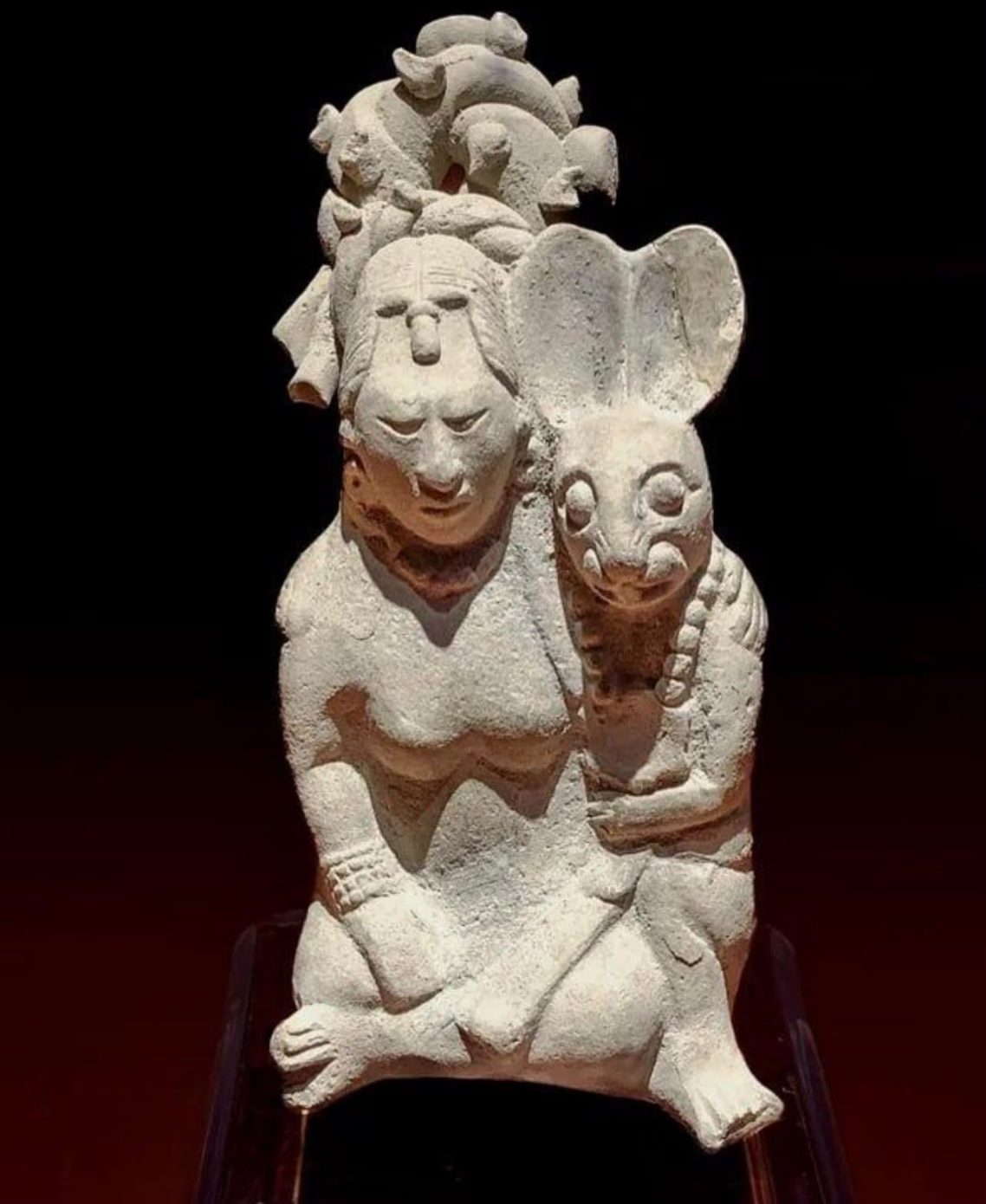
One of the clearest surviving examples is a Late Classic Maya ceramic figurine, dated to approximately AD 600–800, now held by the Princeton University Art Museum.
The Moon Goddess and Her Rabbit
The sculpture pairs a young female figure with a rabbit. The museum identifies the woman as the Moon Goddess and interprets the association with reproductive power in relation to the rhythms of the Moon.
The significance of this object lies partly in its simplicity.
The goddess is not accompanied by a jaguar, serpent or formidable mythical beast. Instead, the animal beside her is a rabbit.
For an agricultural society closely observing the natural world, the rabbit’s reproductive capacity offered a readily understandable parallel with fertility and renewal.
The Moon’s repeated disappearance and return could similarly suggest the continuation of life through recurring periods of change.
It is tempting to interpret the rabbit as a messenger between the earthly and divine worlds. Although this is a meaningful contemporary spiritual reading, the surviving evidence does not establish that such a role was universally assigned to rabbits by the ancient Maya.
What the evidence does establish is the close visual relationship between the lunar goddess and her animal companion.
The rabbit belonged within the goddess’s sacred imagery.
The Rabbit as a Participant in Divine Events
The rabbit’s significance extends beyond its association with fertility.
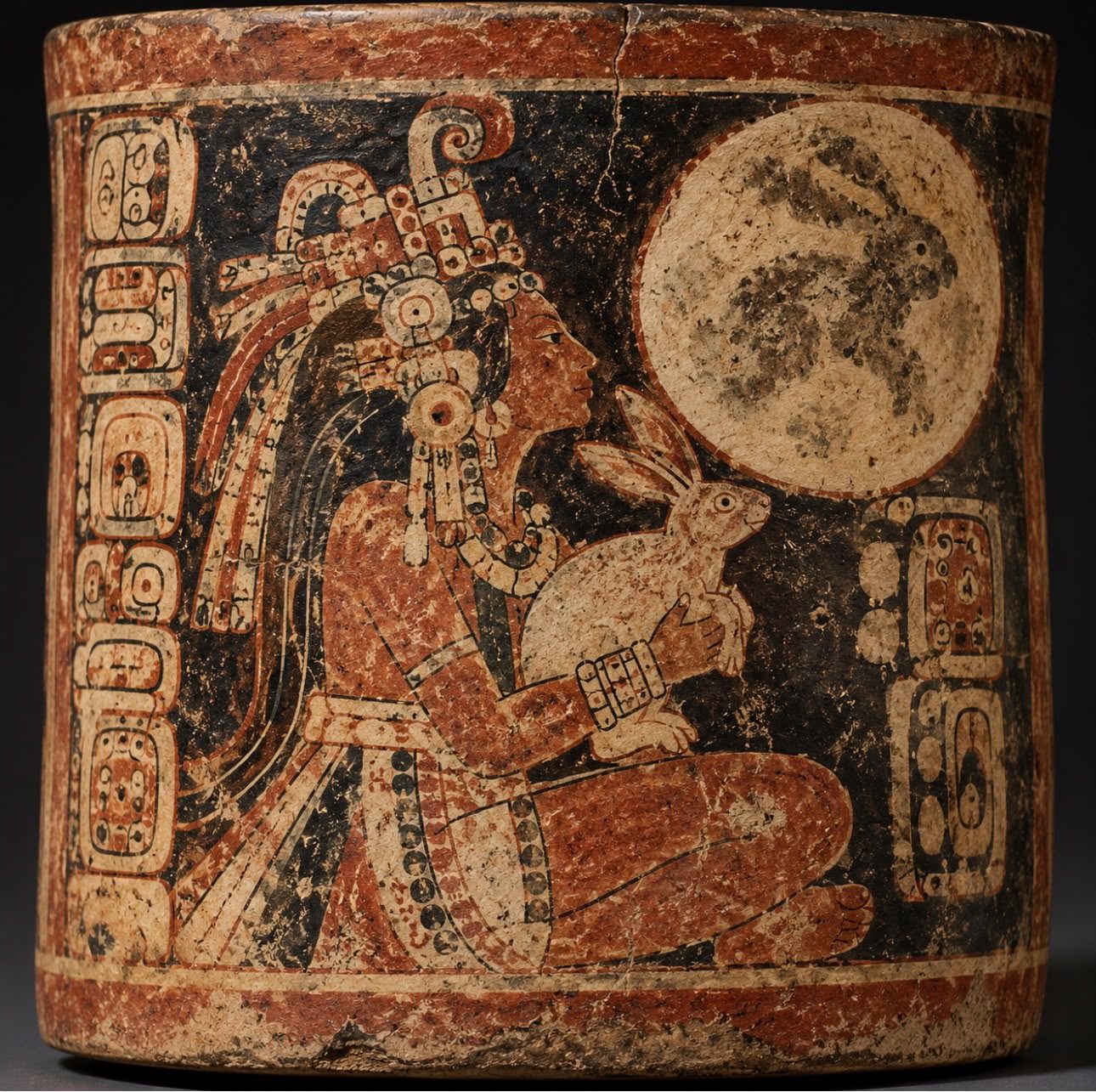
Some surviving Maya ceramics portray rabbits taking active roles in elaborate mythological scenes. A particularly fascinating example is a Classic Maya drinking vessel held by the Los Angeles County Museum of Art. In this scene, the Moon Goddess presides over a gathering of celestial beings. An underworld deity has been deprived of his ceremonial regalia, which is held by the goddess’s rabbit companion. Four lunar deities appear nearby. The museum interprets the scene as an episode involving the establishment of cosmic order and the cyclical movement of celestial bodies.
This is particularly revealing. The rabbit is not merely decorative. It participates in a story involving supernatural authority, the humiliation of an underworld power and the organisation of the heavens. Such imagery challenges the assumption that sacred animals must represent physical strength or aggression.
The rabbit’s role may instead suggest cleverness, unexpected influence and participation in events far greater than itself. These are qualities that can resonate strongly within contemporary Pagan symbolism.
A Creature of Cycles and Renewal
The natural behaviour of rabbits provides another way of understanding their symbolic appeal. Rabbits reproduce rapidly, respond closely to environmental conditions and occupy an important place within the ecological relationships of their habitats. Their lives are shaped by changing seasons, food availability, shelter and the constant balance between vulnerability and survival. It is understandable that human societies might associate such creatures with fertility and life’s capacity to renew itself.
When these associations are considered alongside the waxing and waning Moon, a powerful symbolic relationship emerges. The Moon changes but returns. Life passes through generations. The natural world repeatedly moves between periods of abundance, decline and regeneration. For modern Pagan practitioners, these parallels can offer a framework for reflecting on personal change. The waxing Moon might represent development and the nurturing of intention. The full Moon might represent recognition or culmination. The waning Moon can provide a focus for release, while the dark Moon invites contemplation before a new beginning. These are contemporary spiritual applications of lunar symbolism, rather than a reconstruction of a specific ancient Maya rabbit ritual. Nevertheless, they draw upon a relationship between the animal and the Moon that has genuine historical foundations.
The Rabbit, the Hare and the Question of Identity
An important distinction must be made between the Maya rabbit and the European hare. The animals belong to the same wider biological family, but they are not identical. The rabbits represented in Maya art belong to the American world, whereas the European brown hare is a different species with its own history and folklore. Yet their physical similarities have allowed both animals to acquire related symbolic meanings in different societies. This is especially important when considering the wider cultural history of lunar animals.
The Jade Rabbit of China, the Moon Rabbit of Mesoamerica and the supernatural hares of European folklore do not belong to one original religion. Their stories developed within distinct cultural settings. Nevertheless, the recurrence of closely related animals in lunar and spiritual imagery presents a fascinating example of how humanity repeatedly finds meaning in the natural world. There is no need to claim that every tradition borrowed from another. The similarities are interesting precisely because the stories are different.
The Maya Moon Rabbit and Modern Pagan Practice
For contemporary Pagan practitioners, the Maya Moon Rabbit offers an opportunity to consider the relationship between observation, symbolism and spiritual intention. It reminds us that sacred meaning need not be confined to monumental temples, powerful gods or elaborate ritual objects. A familiar animal can become a symbol through which people contemplate the rhythms of existence.
In modern practice, the rabbit’s lunar associations can inspire reflection upon renewal, fertility in its broadest sense, adaptability and the recurring opportunities presented by change. Fertility need not refer exclusively to reproduction. It can also represent the development of ideas, creativity, relationships, personal confidence or new directions in life. Similarly, renewal need not involve dramatic transformation. Sometimes it is simply the willingness to begin again.
The Moon Rabbit offers a particularly gentle image for these processes: a creature whose symbolic strength arises not from domination, but from its relationship with the changing natural world.
The Connection to My Moongazing Hares
When I developed my Moongazing Hares, I wanted to create something that could serve as a meaningful spiritual focus without being restricted to one mythology, religious tradition or cultural interpretation. Their form is deliberately simple.
Although I call them hares, their appearance allows them to be understood equally as rabbits. This flexibility is important because it enables the sculpture to connect symbolically with different traditions without attempting to reproduce any one sacred image. The Maya Moon Rabbit is one example. The Jade Rabbit of China is another. Both demonstrate how an animal associated with the Moon can become part of a much larger understanding of life, change and spiritual meaning.
My Moongazing Hares are not replicas of ancient artefacts, nor do I claim that their particular construction or crystal composition derives from Maya religion. They are contemporary Pagan creations, informed by my own spiritual practice and inspired by the wider history of sacred hare and rabbit symbolism. Each hare is individually handmade from reformed crystal.
Within its body is a fixed inner matrix of Selenite, Peach Calcite and Clear Quartz, together with an additional purpose-specific crystal chosen to give that individual hare its intended spiritual focus.
In my practice, these materials and the hare’s physical form work together as a focus for intention, reflection and ritual.
The sculpture becomes something that can be held, contemplated and incorporated into personal spiritual work.
For someone exploring lunar renewal, the Maya Moon Rabbit provides one meaningful historical connection. For someone working with a different spiritual tradition, another aspect of the hare’s symbolism may be more relevant. That is precisely why I chose not to make the sculpture exclusive to one interpretation. Its purpose is not to prescribe what someone must believe. It is to provide a tangible focus through which they can explore their own intentions and spiritual understanding.
An Ancient Image with a Continuing Meaning
More than a thousand years after Maya artists depicted a rabbit beside their Moon Goddess, the image remains immediately recognisable. A small animal, the Moon and the mystery of their relationship. We cannot know every belief held by the individuals who created those ancient objects. Some stories have survived only in fragments, while others remain open to interpretation. Yet the artwork itself demonstrates that the connection was important enough to preserve in clay. For me, that is one of the most compelling aspects of the Moongazing Hare. Its contemporary purpose does not depend upon claiming an unbroken religious tradition stretching back to antiquity. Instead, it recognises that humanity has repeatedly looked towards the same natural world and discovered profound spiritual meaning within it.
The Maya Moon Rabbit is one beautiful expression of that relationship, and every Moongazing Hare I create offers an opportunity to consider what those ancient symbols might mean in our own lives today.
Peter Loy – The Pagan Psychic